GEO · AEO · AGENTIC-READY

GEO implementation for agencies.

For websites humans love and machines understand. flize makes your clients' sites machine-readable and AI-/LLM-agent-ready. Your agency's own service, without building a dev team. Real fixes, conveniently delivered into the dev team via the MCP server.

white-label multi-client made in germany
readiness · client.com scan.01
58
AI readiness
58 / 100 · room to grow
semantic HTMLok
Schema.org / JSON-LDmissing
llms.txtmissing
AI-crawler accesspartial
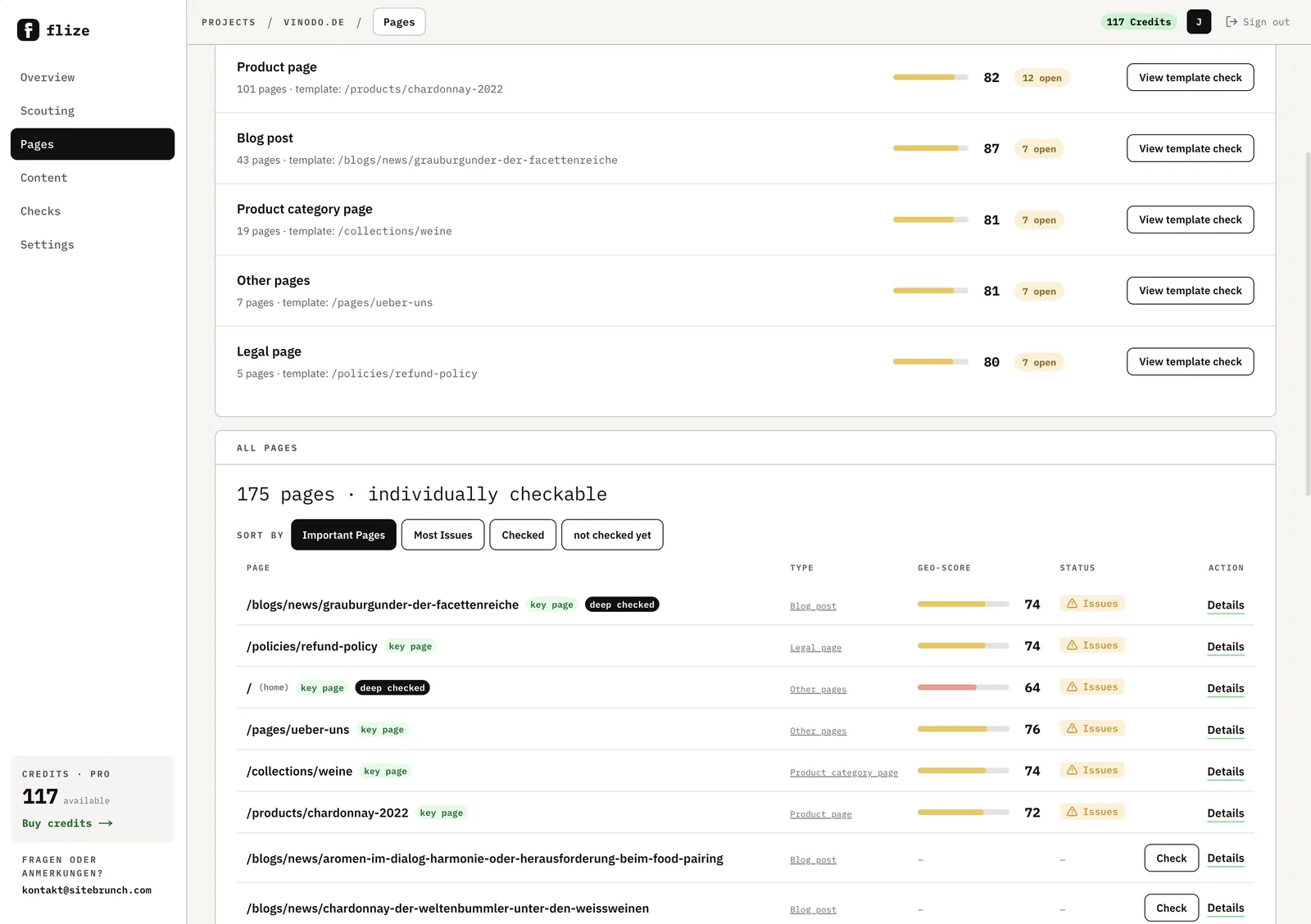
flize fix → PR with 3 patches 58 → 94
sec.01, the shift

SEO becomes GEO.

Google AI Overviews, ChatGPT, Perplexity, Gemini. Users get finished answers instead of ten blue links. Whether you show up in those answers is no longer decided by backlinks alone, but by whether machines can read the page cleanly in the first place.

Your clients are already asking: “Do we get mentioned in ChatGPT?” Monitoring tools hand them a score for that. But actually improving that score, really implementing semantic HTML, schema, llms.txt and crawler access, is something agencies lack the time, dev capacity and tooling for.

That's exactly the gap flize fills: the implementation.

[ai-traffic]
+1200%
growth in AI referrals to websites (2024 to 2026)
[zero-click]
60%
of searches end without a click on a result
[fix-gap]
0
monitoring tools that actually fix the page
sec.02, services

Everything that makes a page
agentic-AI-ready.

flize covers the complete technical GEO implementation, from semantic HTML to crawler access. Delivered as patches, not as a PDF audit. The website is the core; everything else builds on it.

core · websitehtml

Semantic HTML

Clean hierarchy, real tables, meaningful structure. The foundation that lets crawlers and LLMs understand content at all.

  • · H1 to H3 & landmark structure
  • · real <table> instead of div-grid
  • · ARIA & reading order
core · markupjson-ld

Schema.org & JSON-LD

Structured data that answer engines consume directly, Product, FAQ, Organization, Article, HowTo.

  • · entity & knowledge markup
  • · FAQ & HowTo schema
  • · rich-result validation
core · accessllms.txt

AI-crawler access

llms.txt, robots & clean sitemaps, so GPTBot, ClaudeBot, PerplexityBot & Google-Extended find the right thing.

  • · llms.txt & llms-full.txt
  • · bot-allowlist tuning
  • · canonical & sitemap
core · contentanswer

Answer-ready structure

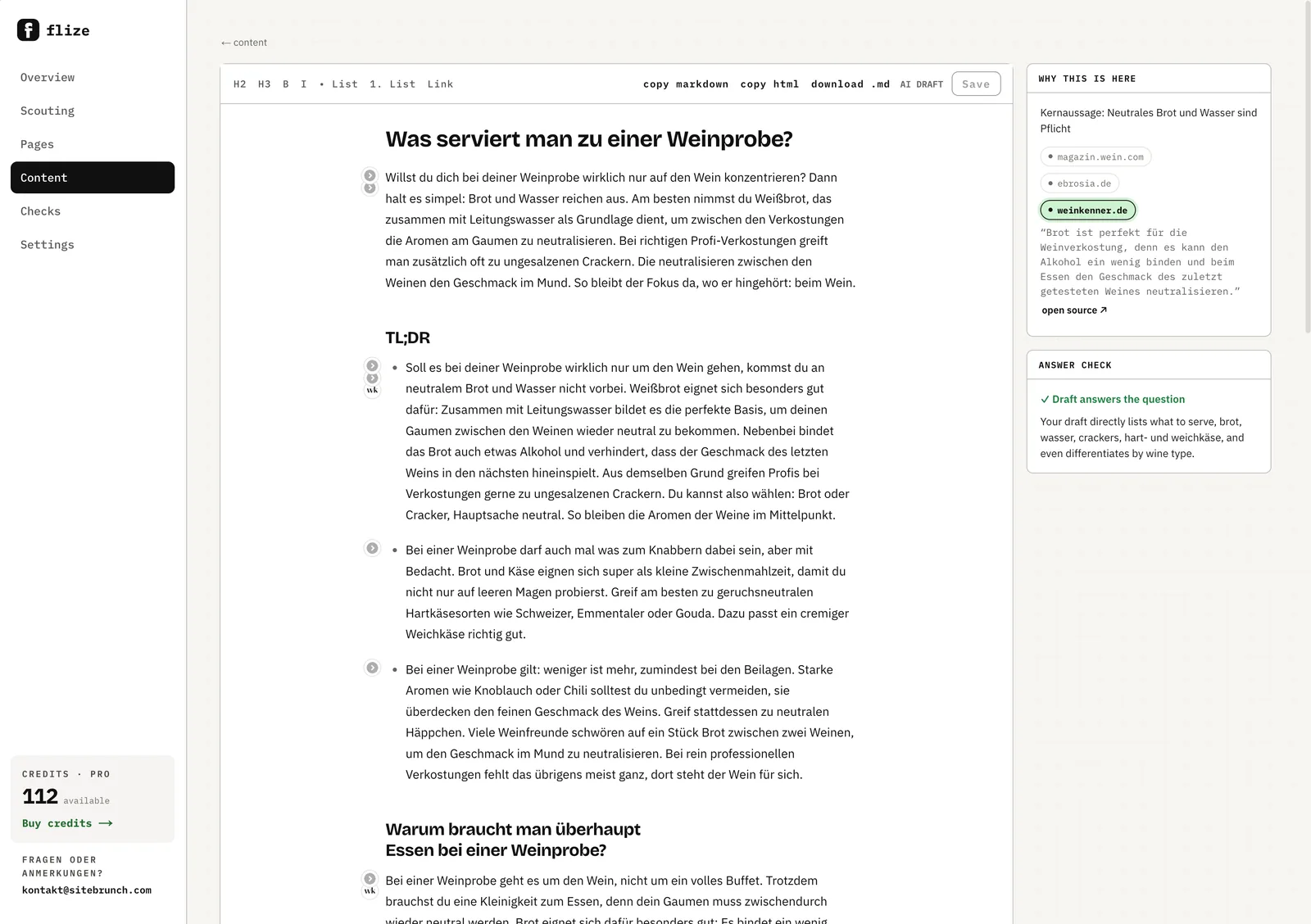
Content laid out so LLMs can lift it as citable answer blocks, definitions, Q&A, clear claims.

  • · extractable answer blocks
  • · entities & facts
  • · source/author signals
delivery · mcppatch

Patches into the dev team

No to-do list, executable fixes, conveniently transferred into the dev team via the MCP server.

  • · MCP: Cursor / Claude Code
  • · one PR per sprint
  • · CMS snippets as fallback
bonus · legacypdf→html

PDFs made machine-readable

Good sites have few PDFs, but if they do: we convert them into structured HTML instead of leaving them invisible to the AI index.

  • · tables stay tables
  • · headings & hierarchy
  • · served on a subdomain
sec.03, the distinction

Monitoring shows the what.
flize delivers the how.

Tools like Peec AI, Profound or Otterly track your AI visibility. That's valuable, but it's a report, not a fix. flize is the layer after: the analysis turns into implemented changes.

monitoring toolsreport
Track brand mentions in AI answers
Show visibility scores & competition
Change nothing on the website
Deliver no actionable fixes
result · you know something is missing
flize · implementationfix
Implements semantic HTML & schema
Delivers patches via MCP into the dev team
Crawler access, llms.txt, answer structure
Re-checks until the score actually rises
result · the page is genuinely ai-ready
// complementary

Already using a monitoring tool? Perfect. flize doesn't replace it, flize implements what it finds. Send us the report, we deliver the patches.

sec.04, implementation

From “missing” to merged.

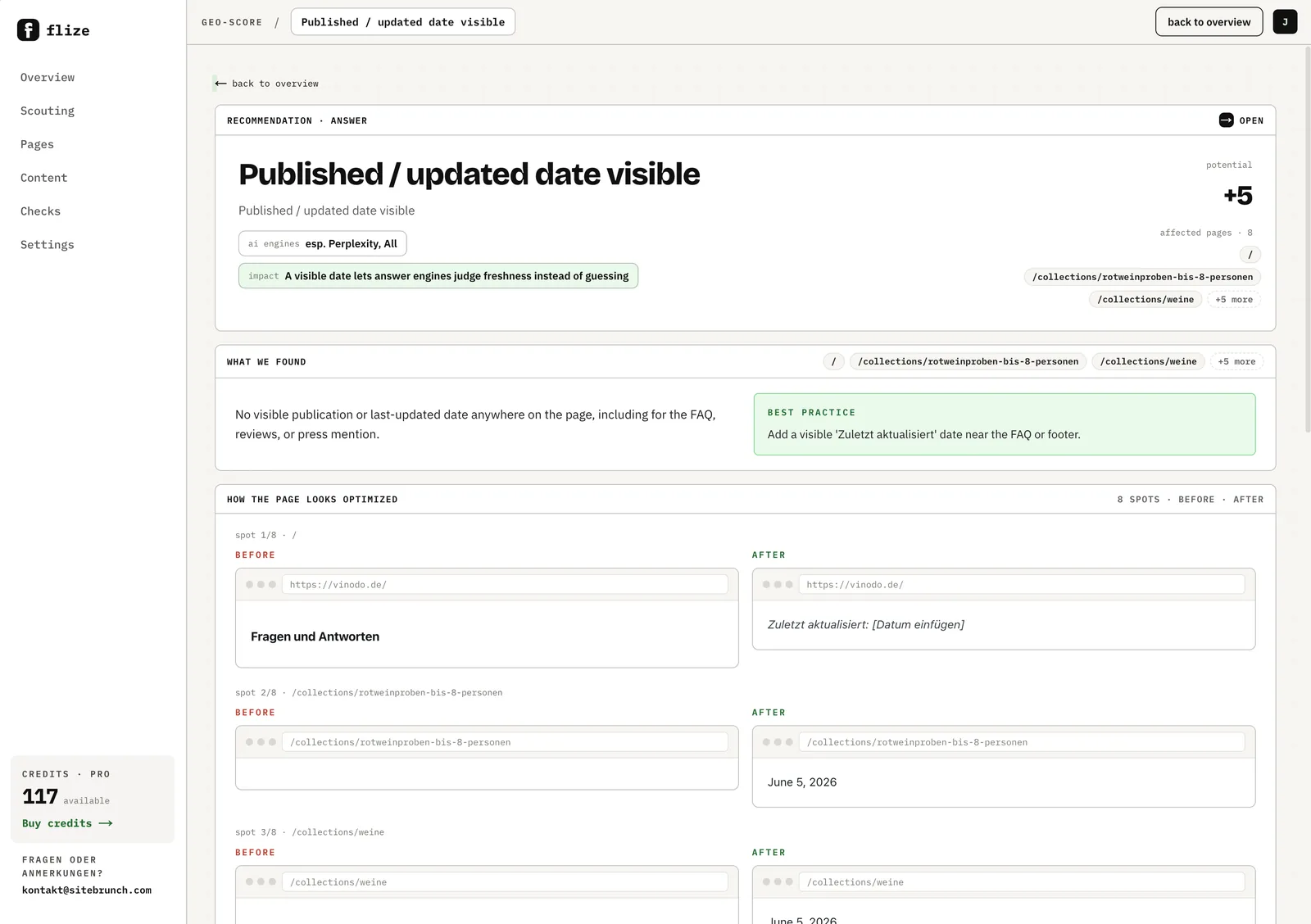
flize doesn't deliver an audit to file away. Per page, a concrete before/after view and executable changes, straight to the dev team's coding assistant via MCP. What fits gets merged.

before · /a200.htmlscore 41
<div class="prod">
  <div class="big-title">A200</div>
  <div class="grid">
    <div>Power</div><div>200kW</div>
    <div>Torque</div><div>420Nm</div>
  </div>
  <img src="a200.jpg">
</div>
No h1. Table as grid. No schema.
after · optimisedscore 94
<article itemscope itemtype="Product">
  <h1 itemprop="name">A200 Drive</h1>
  <table aria-label="Technical data">
    <tr><th>Power</th><td>200 kW</td></tr>
    <tr><th>Torque</th><td>420 Nm</td></tr>
  </table>
</article>
H1 · semantic table · Schema.org · AI-ready
channel
Straight into the IDE
Via MCP: Cursor, Claude Code, Continue, whichever assistant the team uses.
control
Always your team
Suggestions, no auto-merge. You decide what goes in.
sec.06, for agencies

Built for teams that
manage many domains.

profile 01seo / geo

SEO & GEO agencies

You advise on visibility in AI search, and want to deliver the implementation, not just the report. flize is your technical workbench.

  • · sell GEO as a new service
  • · implementation, not just audit
  • · measurable score gains
profile 02digital

Digital-marketing agencies

Full service without a dev-heavy team of your own. flize delivers the technical AI readiness as a module you offer under your name.

  • · white-label reports
  • · no dev build-up needed
  • · new retainer module
profile 03in-house

In-house teams, many domains

A group or corporation with dozens of brand sites. One dashboard, one standard, AI readiness across the whole portfolio.

  • · multi-domain at a glance
  • · one consistent standard
  • · roles & approvals
white-label
Your logo, your report
Readiness reports and score sheets under your brand, to the client.
multi-client
All clients, one board
Domains, scores and open fixes managed centrally per client.
partner
Margin included
Partner terms so GEO becomes a profitable service package.
sec.07, why ongoing

GEO isn't a project.
It's a retainer.

Which sources AI cites changes daily. AI Overviews swap sources, models get new data, Perplexity weighs things differently. Whoever optimised once isn't “done”, they're currently stable.

At the same time the client sites change: new pages, new products, relaunches. Without an ongoing pipeline, every new page falls back to the old level.

That's exactly what makes GEO a recurring business: flize re-crawls at your chosen cadence, tracks the score and ships new patches, an argument for the monthly retainer.

7d
re-crawl default
diff only
PR
per sprint
// web-mcp · agent ux

Designed for humans,
usable by machines.

Search, AI answers, agents, the way sites get used is shifting. "Your next customer isn't human" isn't a slogan; it's the shift already underway.

The full story

flize makes your most important conversion paths directly usable for AI agents: purchase, booking, sign-up. We design the agent journey visually, ship it as WebMCP tools on your own domain, and measure which agent triggers which action, cleanly at the tool level instead of via traffic rates. For the first time you see side by side how humans and agents convert, and optimise both journeys. EU-hosted, GDPR-compliant, without rebuilding your existing site.

visually designed agent journey webmcp tools on your domain measured at tool level eu-hosted · gdpr-compliant
sec.08 · startapp.flize.io
2 credits free · no credit card

Straight into
the tool.

Sign up, get 2 credits free and test your first domain right away. Buy credit packs later, inside the tool, no subscription.

Start for free
2 credits free no subscription no credit card
sec.09, faq

Real questions.
Clear answers.

Is flize a monitoring tool like Peec AI?

+

No. Monitoring tools track AI visibility, they show what's missing. flize is the layer after: the implementation. We make websites genuinely machine-readable and AI-/LLM-agent-ready, with semantic HTML, Schema.org, llms.txt and crawler access. You can keep using your monitoring tool; flize implements what it finds.

What exactly does flize implement?

+

Semantic HTML (clean hierarchy, real tables), Schema.org / JSON-LD markup, llms.txt and AI-crawler access (GPTBot, ClaudeBot, PerplexityBot, Google-Extended), plus an answer-ready content structure. Bonus: existing PDFs are converted into structured HTML. Delivered as patches, not as an audit PDF.

How does the implementation get into the client website?

+

flize delivers executable changes via MCP straight into the coding assistant (Cursor, Claude Code, Continue) or as a pull request into the repository, review-ready, bundled per sprint. For sites without a dev team there are CMS snippets as a fallback. What gets merged is always decided by the agency's or client's team.

Is there white-label & multi-client?

+

Yes. Readiness reports and score sheets run under your brand, all clients live in one central board with scores and open fixes. Partner terms make sure GEO becomes a profitable service package, ideal as a new retainer module.

Where is the data processed?

+

Processing and LLM inference run entirely in the EU, hosted in Frankfurt am Main. No US providers, no training reuse of client data. DPA included on signing, a strong argument you can pass straight to your clients.

What does flize cost?

+

flize runs on credits, no subscription: 1 credit = 1 page readiness test. You get 2 credits free on sign-up to start straight away. After that, credit packs start at €5 (5 credits); bigger packs are cheaper per test, up to 60% savings. All details on the pricing page.